THE RAVEN
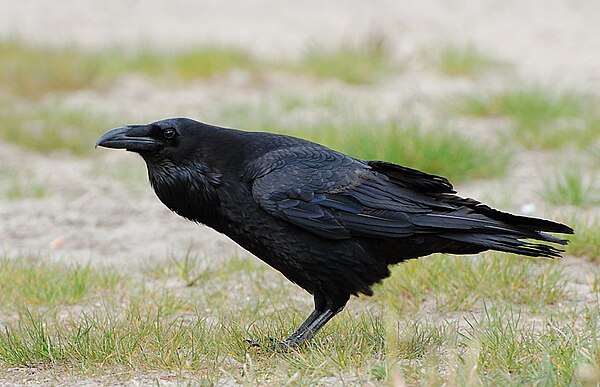
I — Etymology & Linguistic Roots
Old English to Proto-Indo-European
The word "raven" descends from Old English hraefn, tracing back through Proto-Germanic *hrabnaz. Shared across all Germanic languages: Old Norse hrafn, Danish ravn, German Rabe, Dutch raaf. The name is fundamentally onomatopoetic — it echoes the bird's harsh, distinctive croaking call. (Wiktionary — raven)
Latin and Greek
Latin corvus derives from Proto-Indo-European *korh2wos. Greek korax ("raven") and korone ("crow") share this origin, as do Old Church Slavonic kruku and Lithuanian krauklys. The convergence is striking: across Indo-European language families, the raven's name emerges from the sound it makes. The bird named itself.
II — Ancient Mythology & Religion
Norse: Huginn and Muninn
Odin keeps two ravens — Huginn ("Thought") and Muninn ("Memory"). They fly across Midgard every day at dawn, gathering intelligence from the nine realms. Odin is called Hrafnagud — "Raven-god." (Wikipedia — Huginn and Muninn)
The ravens represent the dualism of consciousness. Odin's greater anxiety about Muninn suggests memory is more precious than thought itself.
The Raven Banner (Reafan): Viking war standard. Per the Orkneyinga Saga: when the banner's raven wings flapped, victory was assured. When limp, defeat. The mother's prophecy: "Bring victory to the man it's carried before, but death to the one who carries it." (Wikipedia — Raven Banner)
Celtic: The Morrigan and Bran
The Morrigan ("Phantom Queen") — goddess of war, fate, and prophecy who appears as a raven above battlefields. The Triple Goddess includes Badb ("battle crow"), whose cries determine victory or loss.
Bran the Blessed — his name means "raven" in Welsh. After mortal wounding, his severed head was buried at the "White Mount" in London as a talisman protecting Britain. The head could speak and sang for 87 years.
Tower of London: "If the ravens ever leave the Tower, the Crown and Britain will fall." Eight captive ravens maintained by an official Ravenmaster. (Historic Royal Palaces — The Ravens)
Native American: Trickster-Creator
Among the Haida, Tsimshian, Tlingit, and Tahltan peoples, Raven is simultaneously trickster and creator. Raven Stealing the Sun: In total darkness, Raven transformed into a speck of dirt, was swallowed by a chief's daughter, and as a fussy child-form released the sun through a smoke hole — bringing light to the world. He also gifted fire, salmon, cedar, hunting secrets, rivers, and geography. (Wikipedia — Raven Tales)
Mesopotamia, Bible, and Quran
Epic of Gilgamesh: After the flood, the raven's failure to return signals land — the oldest flood narrative. Elijah (1 Kings 17): Ravens bring bread and meat morning and evening. Quran (Surah 5:31): After the first murder, a raven teaches Cain burial — making it humanity's first teacher of death rites.
Greek: Why Ravens Are Black
Originally white-feathered. Apollo sent a white raven to watch his lover Coronis. When it reported her infidelity, Apollo cursed it, scorching its feathers permanently black. A divine mark of punishment — but also transformation. (Wikipedia — Raven in Greek mythology)
Asian Traditions
Japanese — Yatagarasu (八咫烏): Three-legged crow sent from heaven to guide Emperor Jimmu. Three legs = heaven, earth, humanity. Now the Japan Football Association emblem. Chinese: Xihe mothered ten suns as three-legged crows; Houyi shot down nine to save the world. Korean — Samjogo (삼족오): Symbol of the Goguryeo kingdom, superior even to the dragon. Hindu — Shani Dev: God of karma rides a crow; during Pitru Paksha, crows carry food to ancestors.
Prehistoric Evidence: 40,000+ Years
Neanderthal raven bone (Zaskalnaya VI, Crimea): Etched with near-even lines — symbolic engagement predating Homo sapiens. (PLOS ONE — Neanderthal Raven Bone Study) Gravettian Period (30,000+ years): Raven bones alongside mammoth remains in Moravia — the earliest commensal relationship between humans and corvids.
III — Indigenous & Global Traditions
Australian Aboriginal Dreamtime
Crow (Waa) stole fire from the Karatgurk women, flung coals causing a bushfire that permanently blackened his feathers. Some accounts say Crow became Canopus — the second-brightest star. (Wikipedia — Crow in Aboriginal mythology)
African Mythology
Nephthys, Egyptian goddess of funerary rites, bears the crow as psychopomp symbol.
Tibetan Sky Burial
After vultures consume main flesh in jhator rituals, ravens consume remaining bones mixed with tsampa. The birds transport the soul into the heavens.
III-B — Latin Culture: Spain, Mexico & the Americas
The Language Itself: Cuervo
In Spanish, cuervo — from Latin corvus — means both crow and raven. The language makes no distinction. This linguistic fusion mirrors a cultural one: throughout the Spanish-speaking world, the raven-crow carries a single, charged identity — dark, intelligent, liminal, prophetic. The surname Cuervo is one of the most widespread raven-derived names in the world, with over 29,000 bearers in Colombia alone, followed by Mexico and Spain. Dozens of towns bear the name El Cuervo across Andalusia, Castile, and Latin America.
Mesoamerica: Cacalotl — The Aztec Raven
The Nahuatl word cacalotl refers to the common raven (Corvus corax), which is far more prevalent in Mexico than the crow. Fray Bernardino de Sahagun documented it in Book XI of the Florentine Codex, describing the bird as "really black, really charcoal-coloured, a well-textured black: very black." Cacalotl was also a personal name — a prominent Nahua leader of Cuauhtlantzinco bore it. In Aztec glyphs, the cacalotl appears in profile with a slightly open beak and prominent claws. (Mexicolore — Crows & the Aztecs)
Animals associated with Quetzalcoatl — the feathered serpent god — include quetzals, rattlesnakes, macaws, and crows. The raven's role here is as divine companion to one of Mesoamerica's most powerful deities.
Maya: The Raven and the Discovery of Maize
In Maya codex iconography and oral tradition, the crow participates in the discovery of maize — the sacred grain around which all Mesoamerican civilization revolves. According to the Popol Vuh, the gods attempted to create humans from mud, then wood, before finally succeeding with maize dough. The raven, the parrot, the hawk, and the coyote are credited with revealing where the corn was hidden. The raven is thus a co-creator of humanity — a role it shares with Pacific Northwest traditions, though the mythology arose independently.
Spain & Portugal: Saint Vincent and the Guardian Ravens
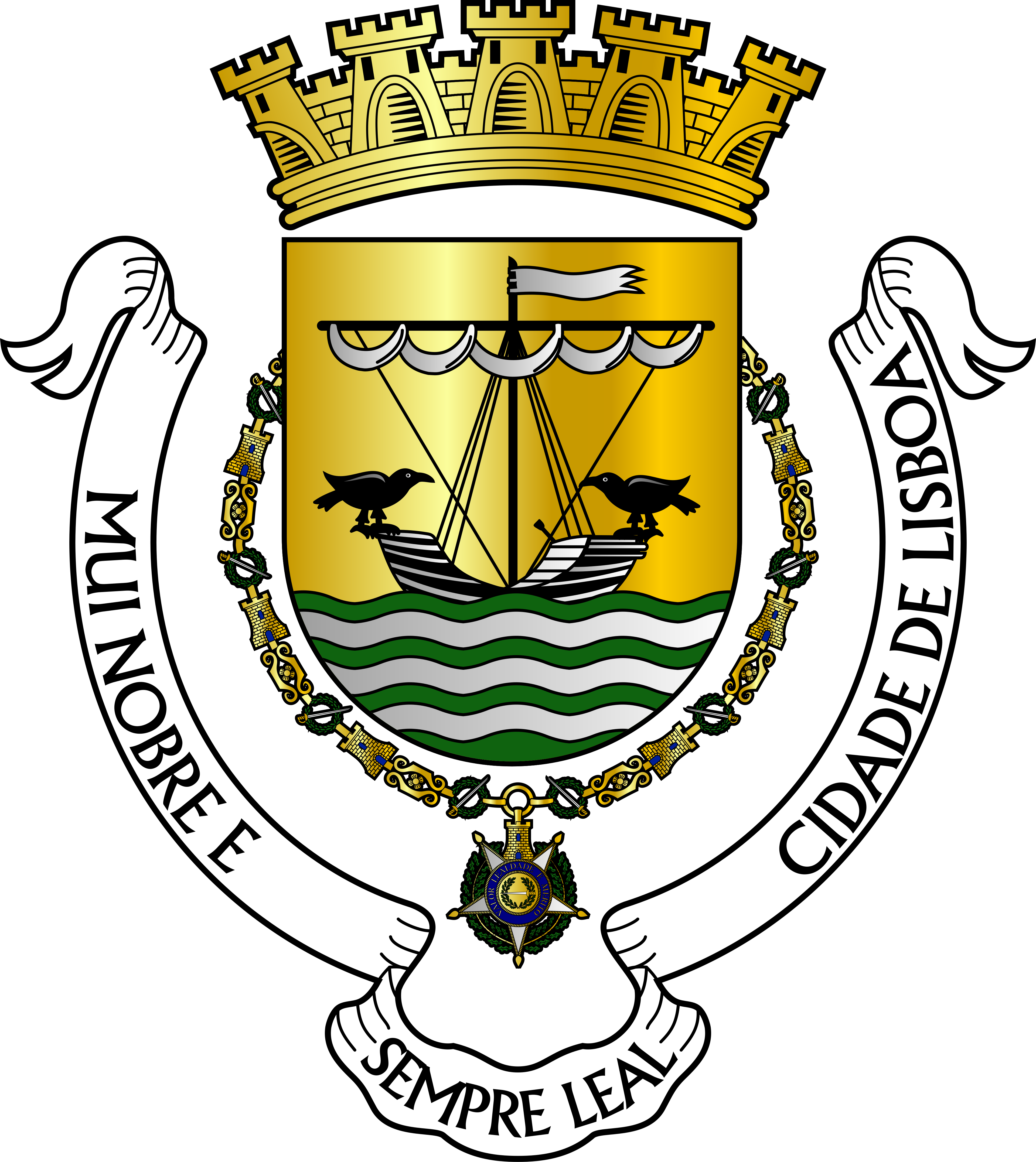
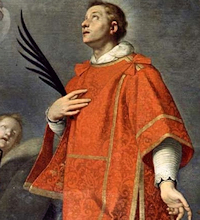
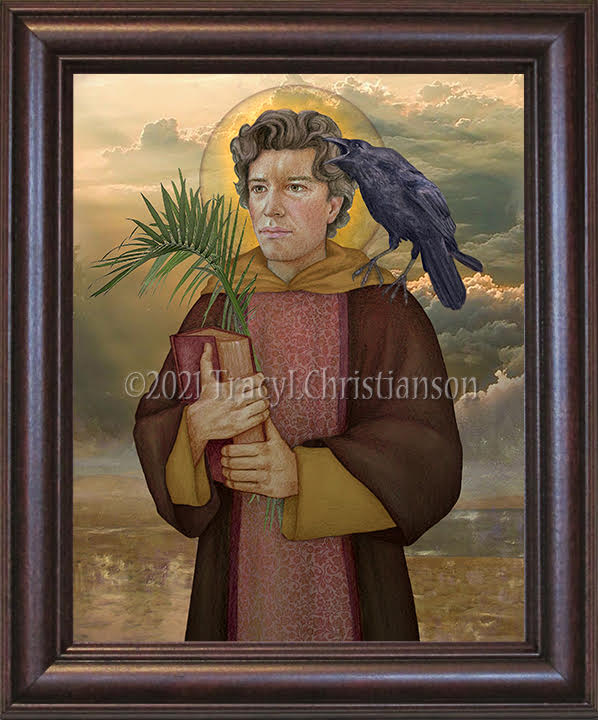
Saint Vincent of Saragossa (d. 304 CE), patron saint of Lisbon, is inseparable from the raven. After his martyrdom under Diocletian, ravens descended to protect his body from vultures and wild animals until his followers recovered the remains. A shrine was built at Cape Saint Vincent on the southwestern tip of Portugal, perpetually guarded by flocks of ravens. The Arab geographer al-Idrisi called the site Kanisah al-Ghurab — "Church of the Raven."
When Afonso Henriques, the first King of Portugal, ordered Vincent's relics transported to Lisbon by sea in 1176, legend holds that two ravens accompanied the ship the entire journey. Today, Lisbon's coat of arms depicts a sailing vessel flanked by two ravens — one of the oldest heraldic symbols of any European capital. The city's iconic yellow trams still bear this crest.
Folk Magic: Brujeria and Curanderismo
Across Mexico and Central America, the cuervo occupies a dual space in folk spiritual practice. In brujeria (folk witchcraft), crows and ravens are considered messengers between worlds — carriers of spells, omens, and the voices of the dead. A raven circling a house signals an approaching death or a visiting spirit. In curanderismo (folk healing), the raven is invoked as a protective guide — its intelligence and fearlessness make it a psychopomp who escorts souls safely through transition.
During Dia de los Muertos, when the boundary between the living and dead dissolves, the raven's association with death transforms from omen to celebration. Ravens appear in altar art, papel picado, and calavera imagery — not as harbingers of doom, but as honored escorts who know the way between worlds.
Jose Cuervo: The Raven as Global Brand
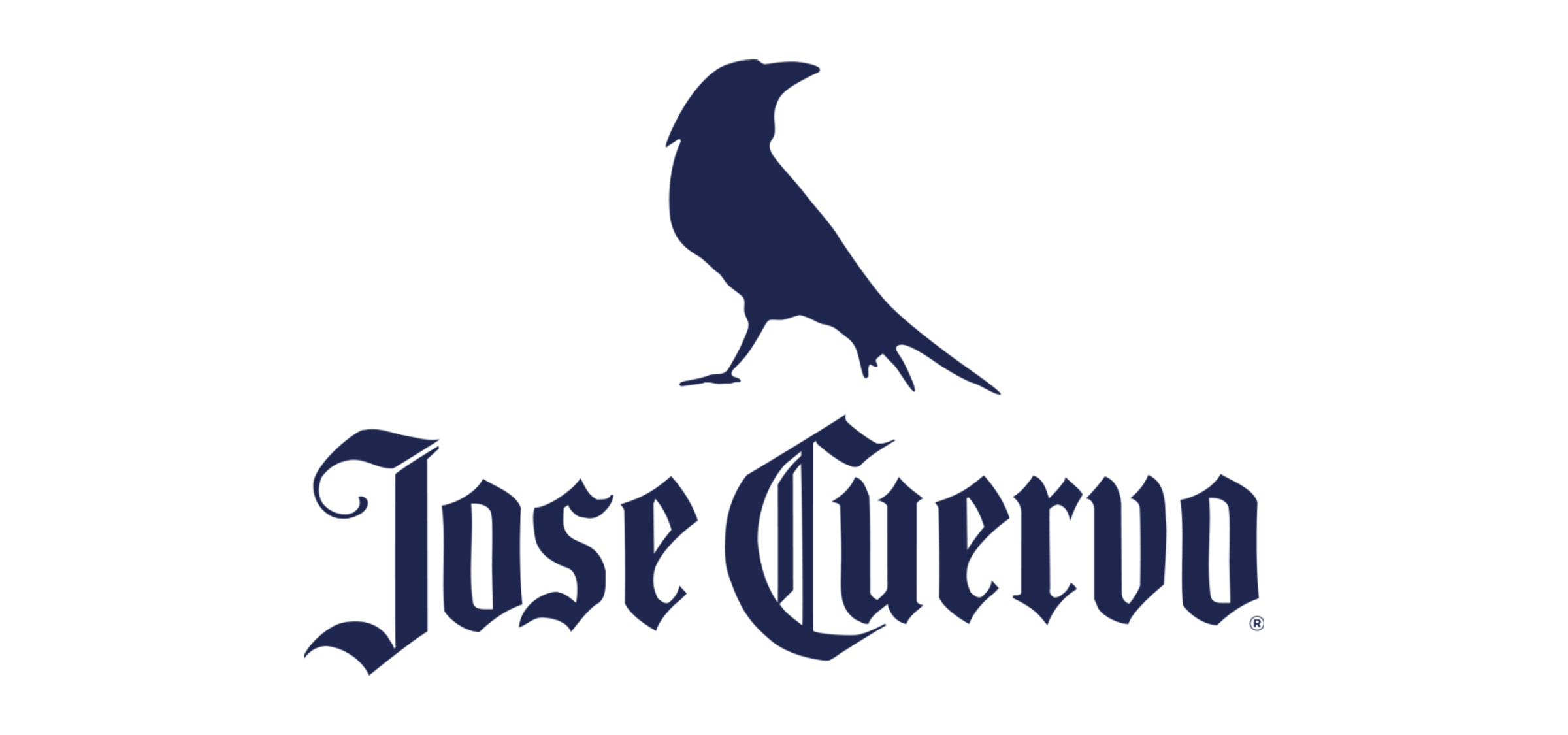
The world's best-selling tequila brand literally means "Joseph Crow." In 1758, Don Jose Antonio de Cuervo received a land grant from King Ferdinand VI of Spain in the town of Tequila, Jalisco. To label his barrels for illiterate customers, he stamped each one with a crow symbol — the family crest. By 1795 his son received Spain's first commercial tequila permit. The raven-marked barrels became an international icon: today, Jose Cuervo sells 8.9 million cases annually in the US alone — one in every five tequila bottles sold. The cuervo glyph on the label is one of the most-seen raven symbols on Earth.
South American Echoes
While the great condor dominates Andean cosmology (representing the Hanan Pacha, the upper world in Inca belief), corvids appear in regional folklore throughout South America. In Patagonia and the Pampas, black birds are associated with the gaucho tradition's fatalism — figures of solitude on vast landscapes. In Argentine and Chilean Spanish, the word carran is sometimes used for crow, while cuervo retains its broader, darker connotation. Colombian folk songs invoke the cuervo as a witness to betrayal and loss — the bird that sees what happens when no one else is watching.
IV — Psychology & Archetypal Symbolism
Jungian Psychology: The Shadow Guide
The raven symbolizes the nigredo — the dark putrefaction phase from which transformation emerges. Jung described ravens as "dark messengers of heaven, who at this point themselves become white." The paradox captures the raven's role in transmutation: shadow work that leads to enlightenment.
Alchemy: Caput Corvi
Caput Corvi ("Raven's Head") — the nigredo phase of the opus. The raven's blackness is transitional — necessary dissolution before reconstruction. "Things must fall apart before they can come together in a new way."
Raven vs. Crow
Ravens embody solitary mystery, esoteric significance, and the psychopomp role. Crows are connected to social intelligence and everyday omens. The crow is close and social; the raven distant and solitary. The crow carries messages; the raven guides souls.
V — Taxonomy & Science
| Rank | Classification |
|---|---|
| Kingdom | Animalia |
| Class | Aves |
| Order | Passeriformes |
| Family | Corvidae |
| Species | Corvus corax (Linnaeus, 1758) |
46-50 species in genus Corvus. 11 accepted subspecies. The most widely distributed corvid on Earth.
| Measurement | Value |
|---|---|
| Length | 54-71 cm (21-28 in) |
| Wingspan | 116-153 cm (46-60 in) |
| Weight | 0.69-2.25 kg |
| Max Speed | ~60 mph |
| Altitude Record | 20,000+ feet |
| Wild Lifespan | 10-15 yr (record: 23 yr) |
| Captive Lifespan | 69+ years |
VI — Anatomy & Physiology
Layer 1: Plumage & External
Entirely glossy black with iridescent purple, blue, green — arising from nanostructured melanosomes, not pigment. Refractive index contrast between melanin (~1.8) and keratin (~1.54) produces multilayer thin-film interference — the same physics as oil on water. Millions of years of optical engineering at the nanoscale.
Layer 2: Muscular System
Pectoralis major: ~17% body mass, 75-95% fast-twitch fibers. Supracoracoideus: Unique pulley mechanism for upstroke. Combined = ~20% body mass, optimized for barrel rolls, tumbling, inverted flight.
Layer 3: Skeletal System

Pneumatized bones: Air spaces reduce mass 20%. Furcula: Fused wishbone resisting wing-stroke forces. Synsacrum: Fused vertebrae creating an immovable unit for flight stability.
Layer 4: Nervous System
Brain ~14g — 6x smaller than a macaque, yet comparable cognitive abilities to great apes. Forebrains contain 2x the neurons per unit volume of primate brains. The Nidopallium Caudolaterale (NCL) functions like mammalian prefrontal cortex. A compact supercomputer.
Layers 5-7: Respiratory, Digestive, Cellular
Respiratory: Unidirectional airflow through 7 air sacs — enables 20,000+ ft flight. Digestive: 90%+ carnivorous; acids that kill carrion bacteria. Cellular: Active telomere maintenance genes contribute to 69+ year lifespans.
VII — Intelligence & Cognitive Science
Multi-Step Problem-Solving: ~90% success rate, comparable to humans. Craft compound tools — previously only humans and great apes. Planning: Cache tools for use 17 hours later (86-89% success). (Science — Ravens plan for the future) Theory of Mind: Adjust behavior based on what competitors have seen. Deception: Pretend to cache food, lead rivals to wrong locations. (Corvid Research Blog)
Ten Extraordinary Facts
1. Four-month-old ravens rival adult chimps in intelligence tests · 2. Plan 17 hours ahead · 3. Intelligence evolved independently from primates yet converged · 4. Perform Aesop's Fable water-displacement test · 5. Memorize relationships over years · 6. Craft tools through insight · 7. Practice deliberate deception · 8. Largest brain-to-body ratio among birds · 9. 100+ vocalizations with regional dialects · 10. 69+ year captive lifespans enable cultural transmission
VIII — Behavior & Remarkable Stories
The Raven-Wolf Symbiosis
100% of wolf kills are visited by ravens (up to 135 on a single kill). Both species play together — tug-of-war, teasing wolf pups. Individual ravens bond with singular wolves. The trinity of wolf, man, and raven in the hunt is ancient. (Wikipedia — Ravens and wolves)
Play, Empathy, and Urban Intelligence
Snow-sledding on lids, rolling down hills, mid-flight object games. Post-conflict consolation based on relationship quality. Ravens understand traffic lights — placing nuts at crossings for cars to crack, retrieving during pedestrian phases.
Famous Pet Ravens
Grip (Dickens'): Could speak, buried coins, bit people. Died 1841, taxidermied. Inspired Poe's "The Raven." Now at the Free Library of Philadelphia. Modern: Loki, Ragnar ("tickle tickle"), Fable (TikTok), Sam.
IX — Edgar Allan Poe's "The Raven"
Published January 29, 1845. Poe received $9 (~$311 today). Reprinted 10 times within a month. The single word "Nevermore" grows increasingly haunting across 18 stanzas. (Wikipedia — The Raven)
The raven symbolized "mournful, never-ending remembrance." Children followed Poe through streets cawing. He became known as "The Raven." Over 350 IMDB credits reference the work.
The Dickens → Poe → Baltimore Chain
Dickens' pet raven Grip → character Grip in Barnaby Rudge → Poe reviewed it → "The Raven" → Baltimore Ravens NFL team. Art inspiring art inspiring art inspiring sport.
X — Literature & Pop Culture
Harry Potter — Ravenclaw: House symbol is actually an eagle — films changed it. Game of Thrones: Three-Eyed Raven = "the world's living, breathing memory" (from Odin's ravens). DC Comics — Raven: Half-demon Teen Titan, Perez designed her silhouette as a bird. Naruto — Itachi: Crows symbolize seeing through lies. The Crow (1994): "When someone dies, a crow carries their soul." Actually filmed using ravens.
Shakespeare: "The raven himself is hoarse / That croaks the fatal entrance of Duncan." (Macbeth) Ted Hughes' "Crow": Trickster-creator poetry. Grimm's "The Seven Ravens": Brothers cursed into raven form. Aesop — The Crow and the Pitcher: confirmed by modern science as real corvid behavior.
Games: Assassin's Creed Valhalla (Synin), God of War Ragnarok (Huginn & Muninn as Odin's forearm tattoos), Bloodborne, Skyrim, Munin.
XI — Brands, Sports & Heraldry
Baltimore Ravens (NFL): Named 1996 by community vote honoring Poe. Purple, black, metallic gold. Mascots: Edgar, Allan, Poe. Live ravens: Rise and Conquer. (SportsLogos.net — Ravens History) Raven Software: Call of Duty developer. Ravenswood Winery: Three interlocked ravens by David Lance Goines — the most tattooed winery logo. (Smithsonian — Ravenswood Poster)
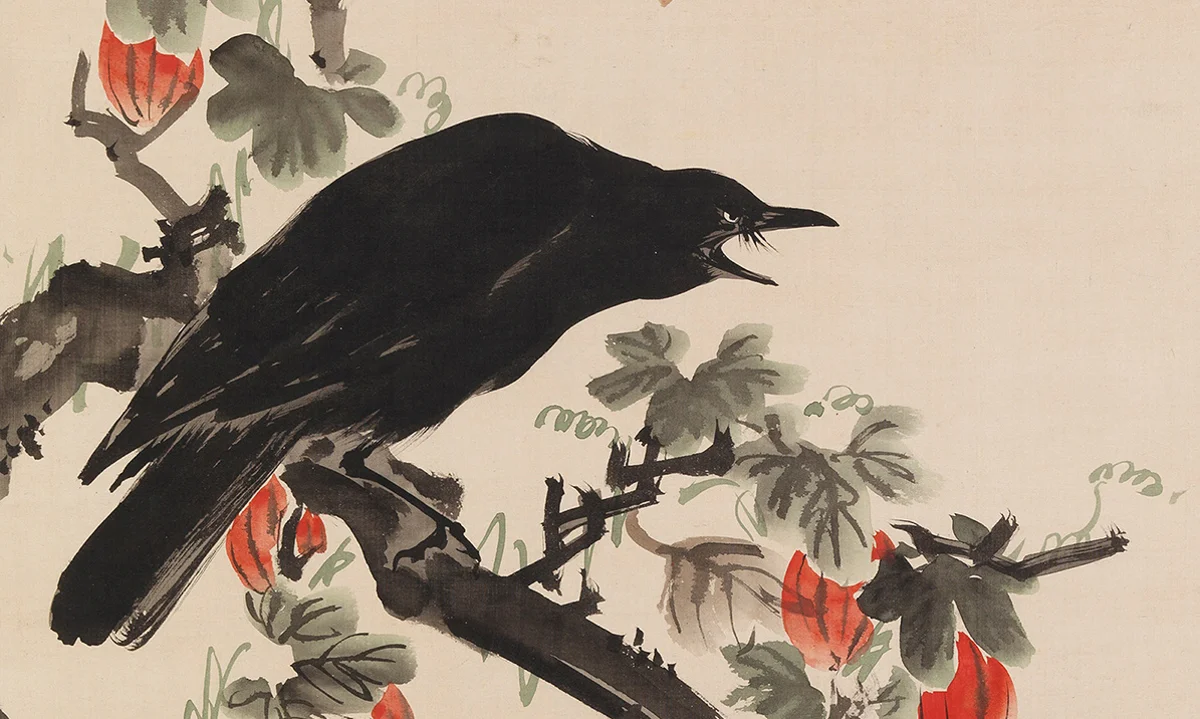
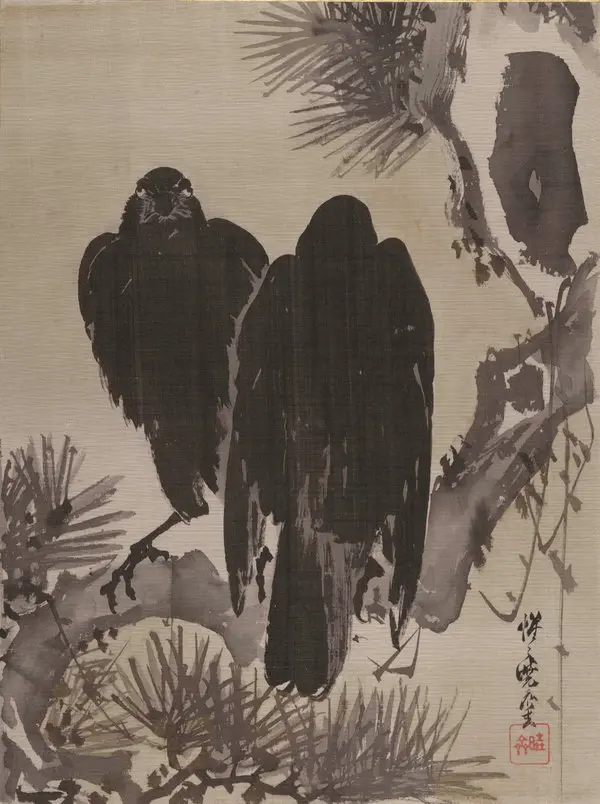
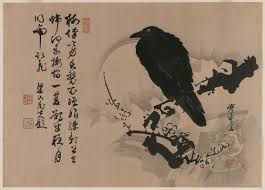
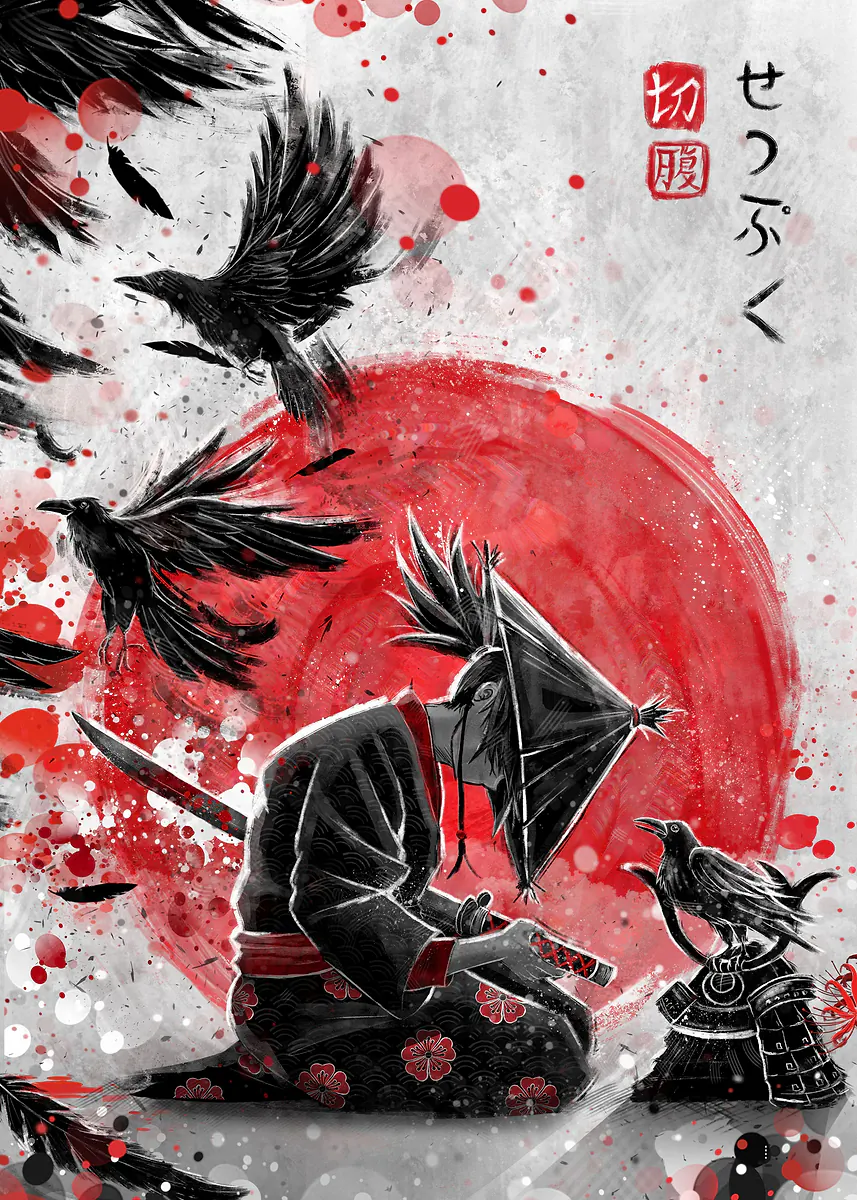
Art History: Gustave Dore's 26 engravings (1884). Manet's Le Corbeau lithographs (Met, MoMA). Audubon's Plate 101. Kyosai's samurai raven prints. Pacific Northwest formline design.
Heraldry: Norwegian Intelligence Service (Huginn & Muninn). Matthias Corvinus' Bibliotheca Corviniana. Tattoo: Nordic/rune, minimalist, realistic blackwork, raven-on-Mjolnir combos.
XII — Military & Music
Military
RQ-11 Raven: Most deployed UAS worldwide. 4.5 ft span, 4.4 lbs, 90 min endurance. Hand-launched, infrared + color video. CIA Ravens (Vietnam): Project 404, Laos. Clandestine forward air controllers called "Shadow Warriors." (Smithsonian — Ravens of Long Tieng)
Music
Raven (NWOBHM): Headlined Metallica's first national tour 1983. Ravens appear 328x in Black Metal, 114x in Pagan Metal. Stranglers — "The Raven" (1979): 3D lenticular cover. Alan Parsons — "The Raven" (1976): Early vocoder. Goth/Witchcraft: Associated with The Morrigan, Baba Yaga, Odin, Bran, Nephthys.
XIII — Colorways & Products
Ford "Raven Black": Deep, solid black on 1960s-70s Mustangs and Thunderbirds. GM "Black Raven": OEM code WA8555. Heritage automotive 1950s-80s. Products: Raven Industries (farming tech), Raven Software (games), Raven Tools (SEO), AeroVironment Raven UAS. Apparel: Raven Brand Inc., Raven Clothing Co. (all-black).
XIV — Creative Synthesis
The Paradox
Simultaneously creator and trickster, harbinger of death and bringer of light, solitary creature forming the deepest interspecies bonds. Darkness containing iridescent color at the molecular level — black feathers shimmering purple, blue, green through nanostructured optical engineering.
What Is This Really About?
Not darkness. The intelligence that thrives at the boundary — between life and death, civilization and wilderness, known and hidden. Transformation: the alchemical nigredo, the shadow work, the necessary dissolution before reconstruction.
The Creative Tension
Smartest bird alive and a garbage-dump scavenger. Symbol of death and a wolf-pup playmate. Optically black and structurally iridescent. 40,000 years of human symbolic engagement and the name of the world's most deployed military drone.
The raven is the Shadow Guide — the archetype of necessary darkness, boundary-crossing intelligence, and transformation through paradox. It sees what others cannot, goes where others will not, and returns with knowledge that changes everything.
Visual Mood Board — Photography
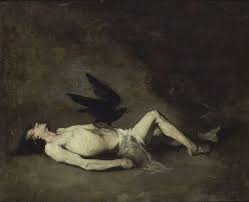
Visual Mood Board — Norse & Viking
Visual Mood Board — Classic Art & Dore
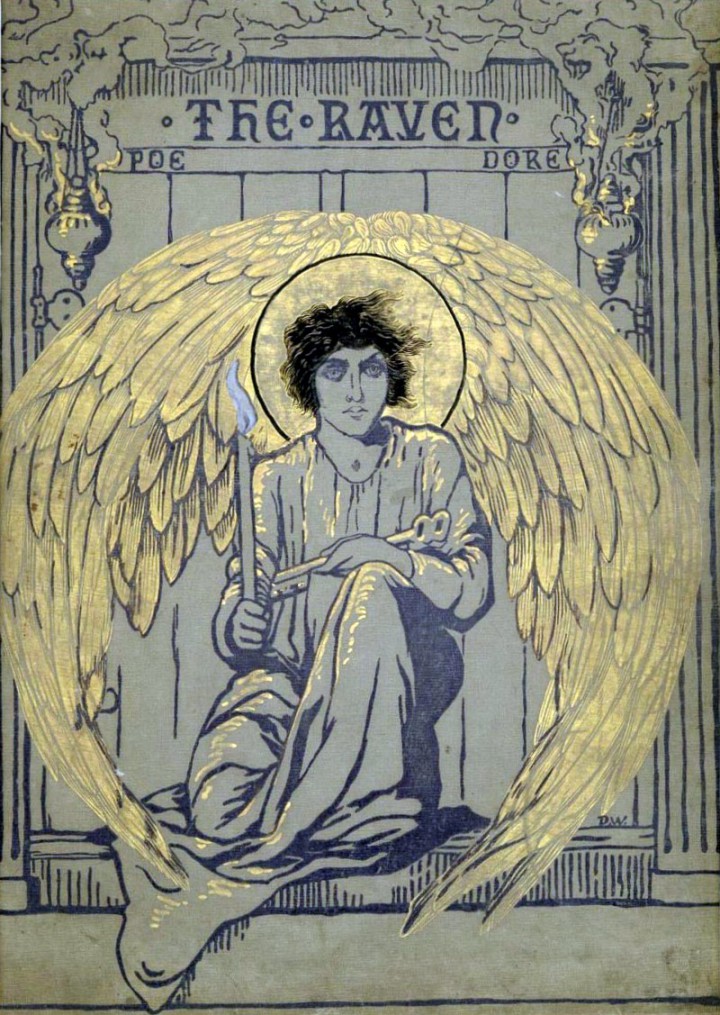
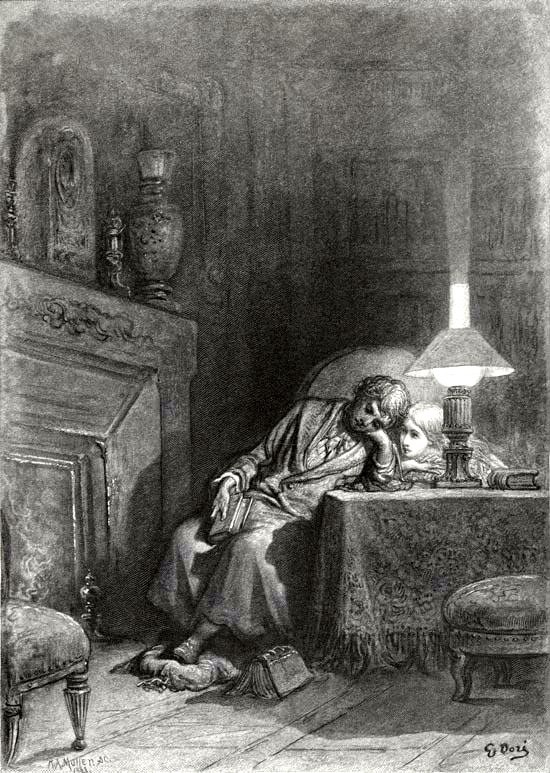
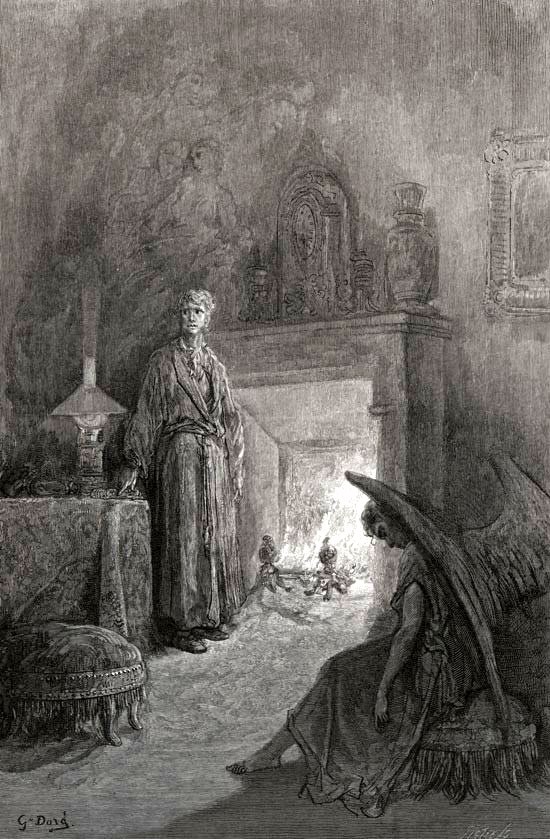
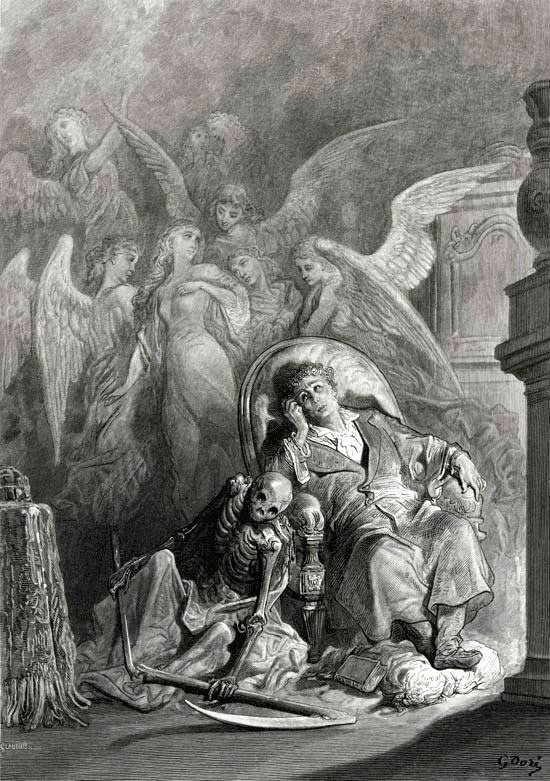
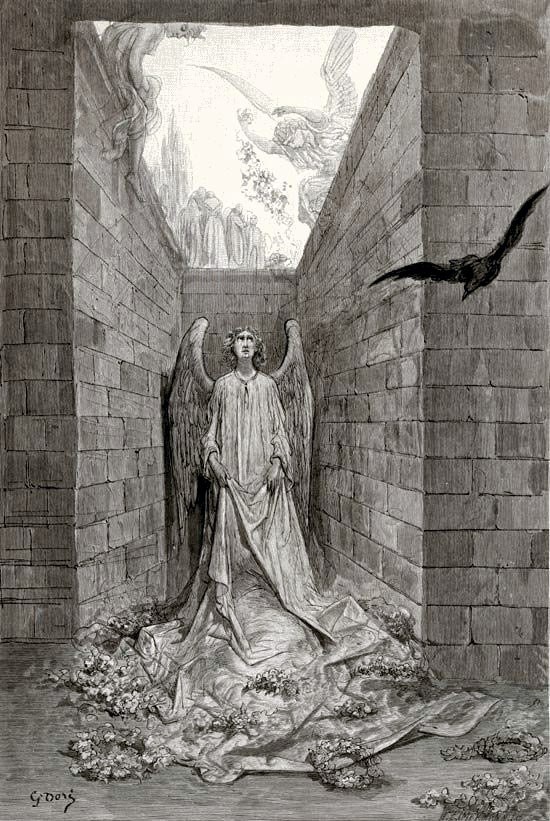
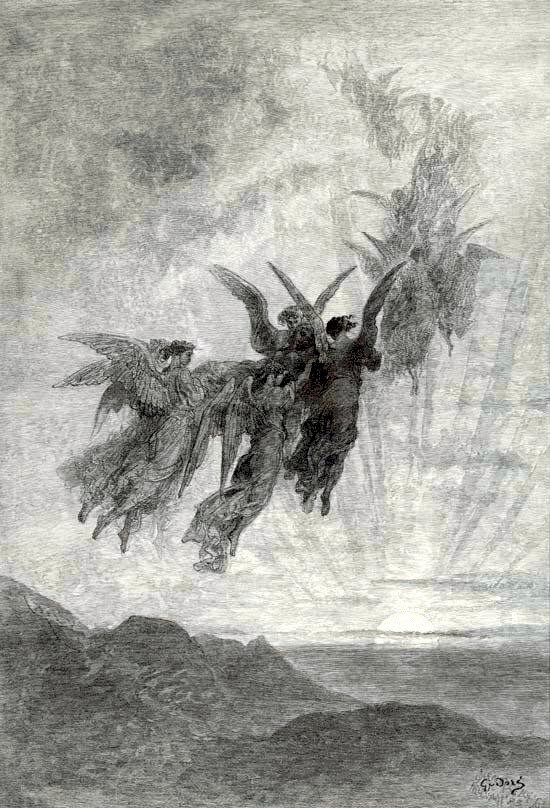
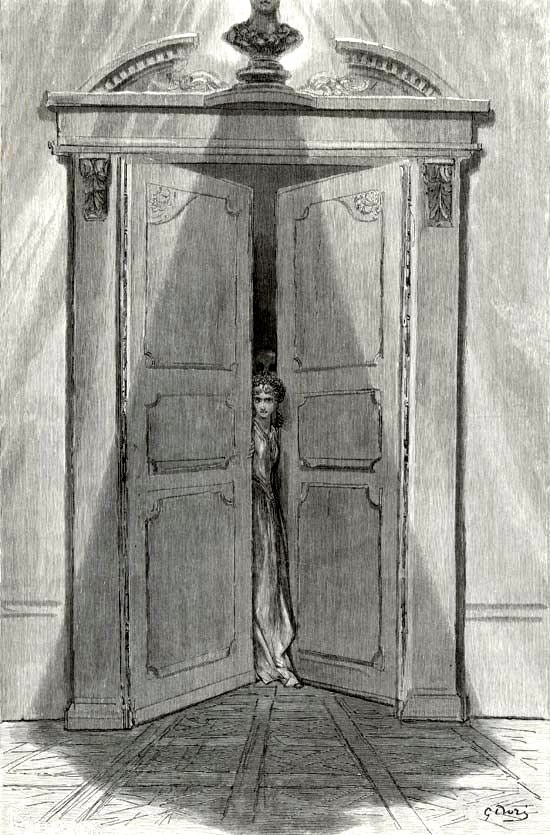
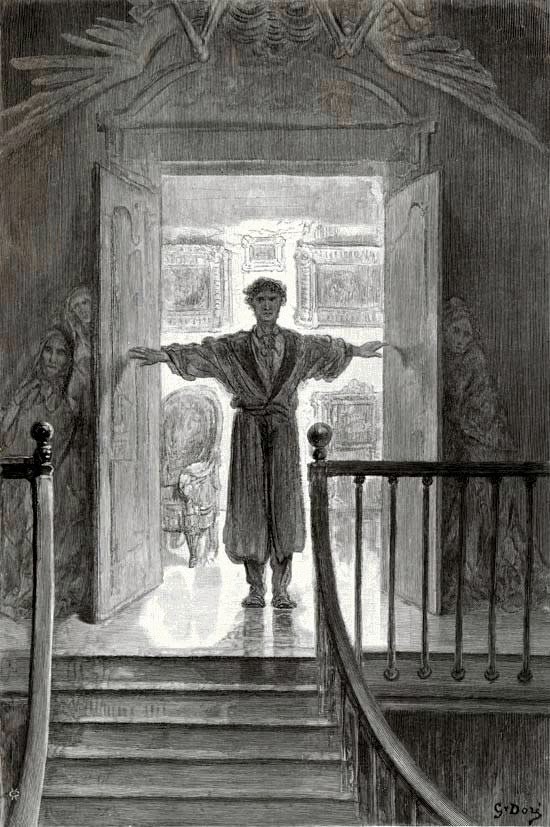
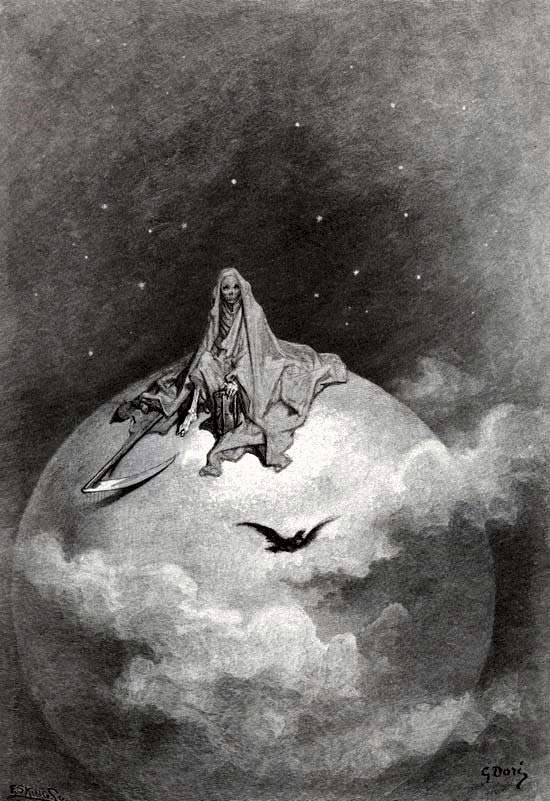
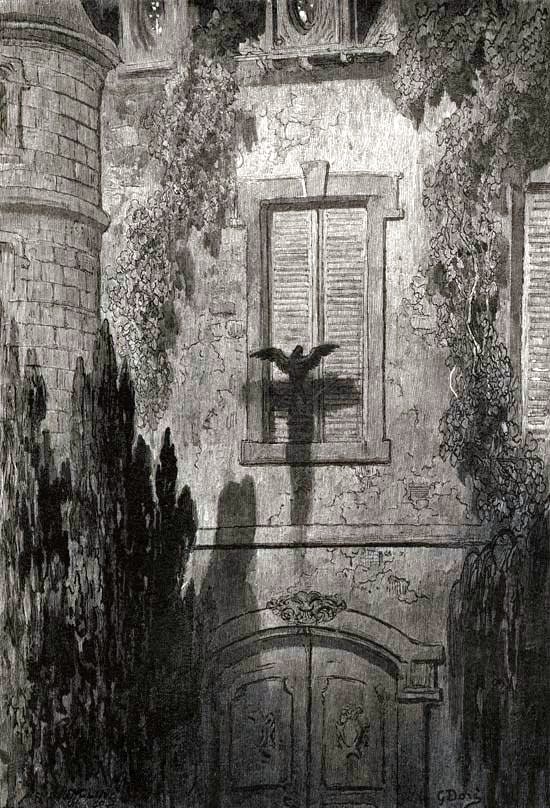
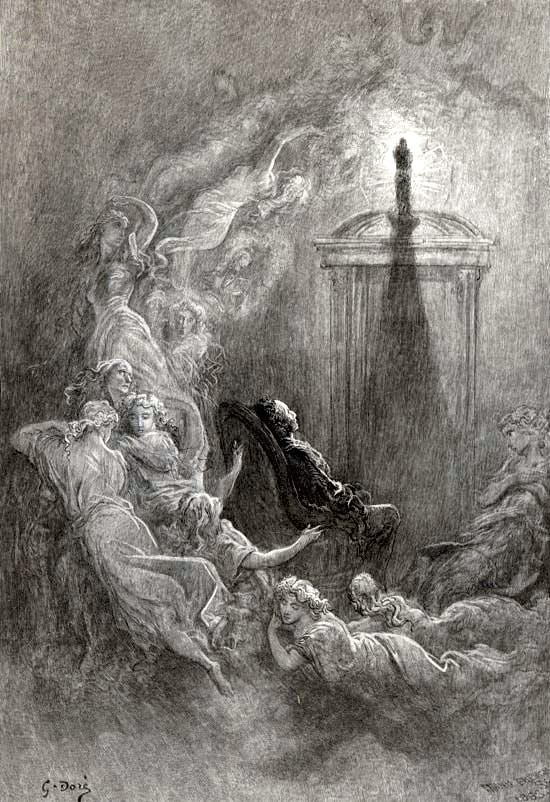
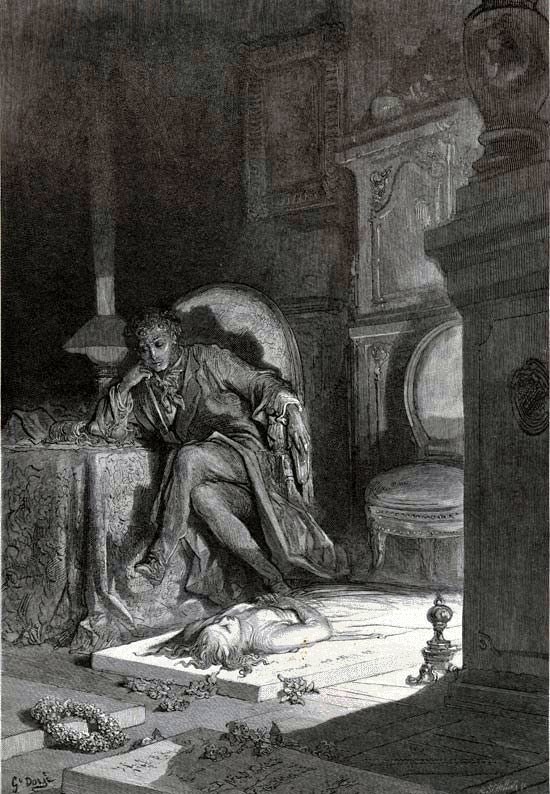
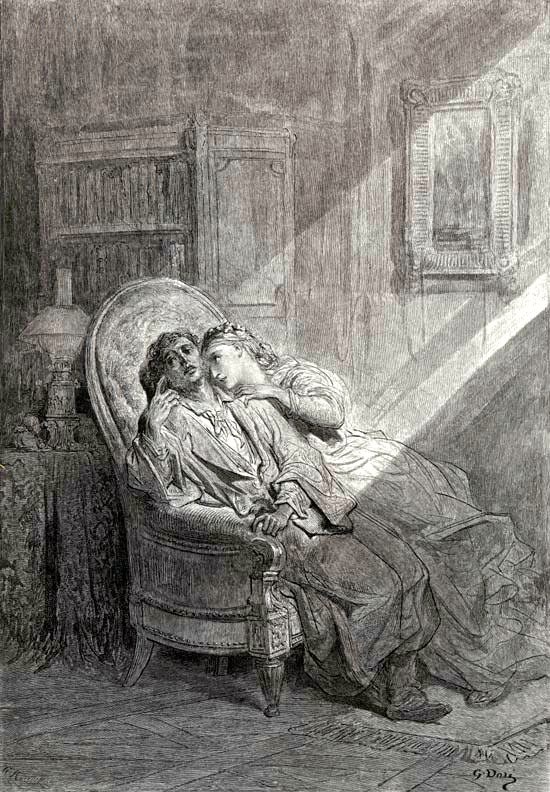
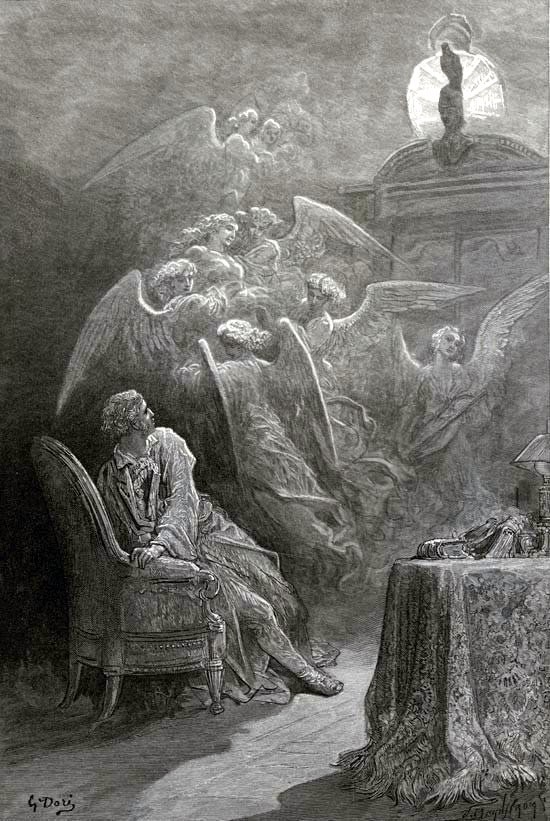
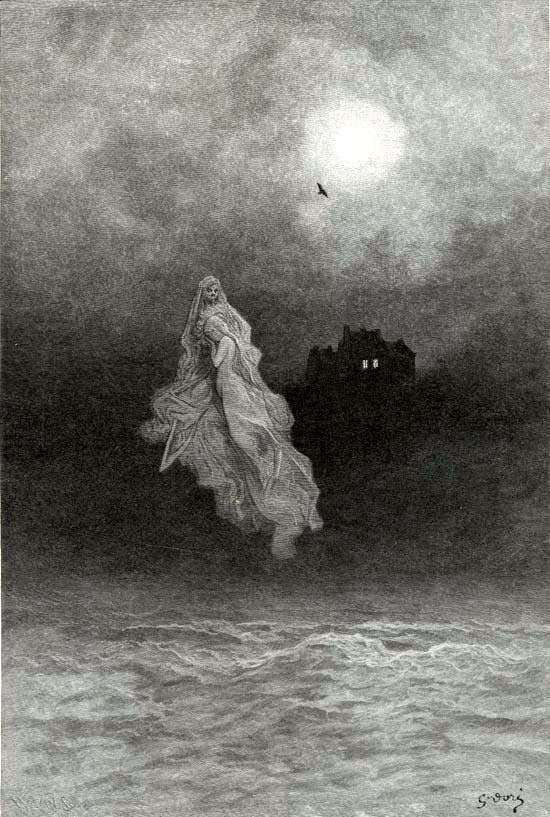
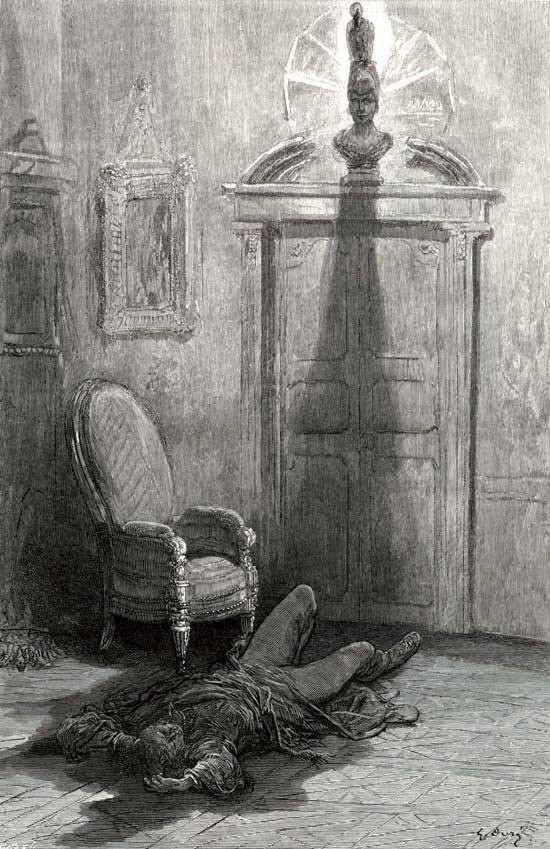
Gustave Dore's Engravings for "The Raven" (1884)
Dore created 26 steel-plate engravings for Poe's poem — one of the greatest illustration projects of the 19th century. Below are the complete set from local assets. (Princeton scholarly analysis | Flashbak complete gallery | Library of Congress — 1884 Edition | Internet Archive — Full 1884 Book)
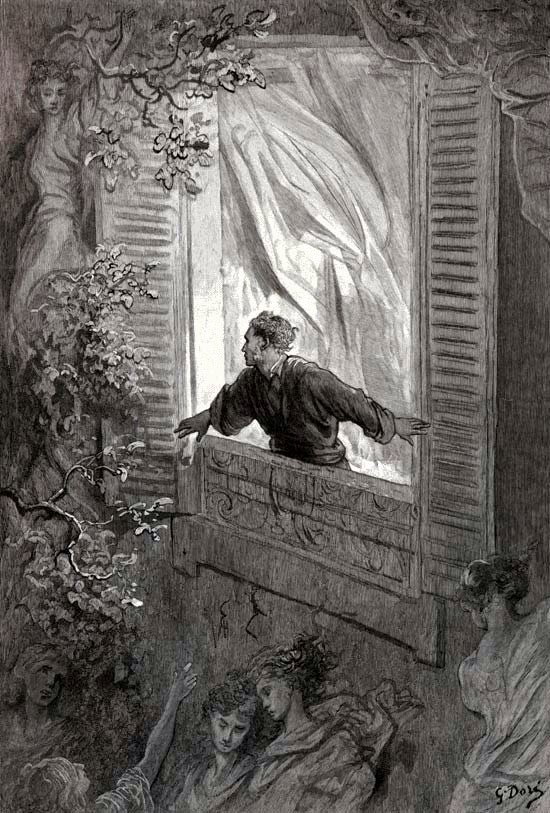
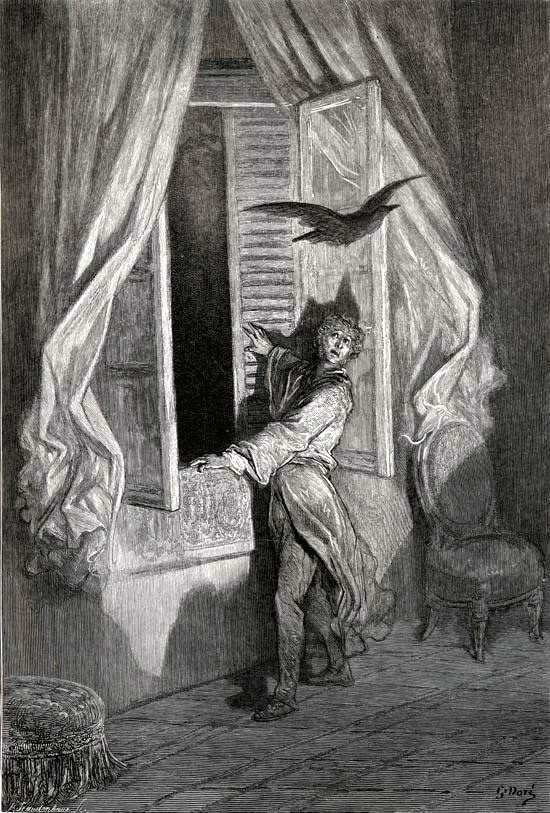
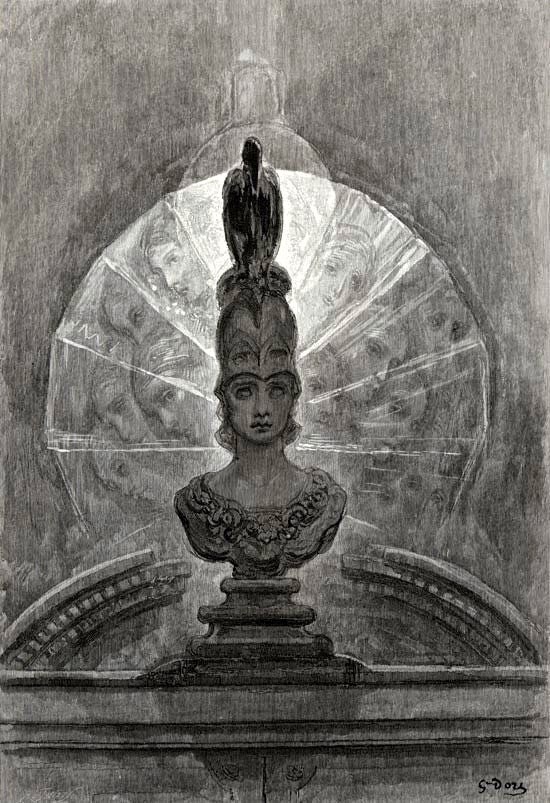
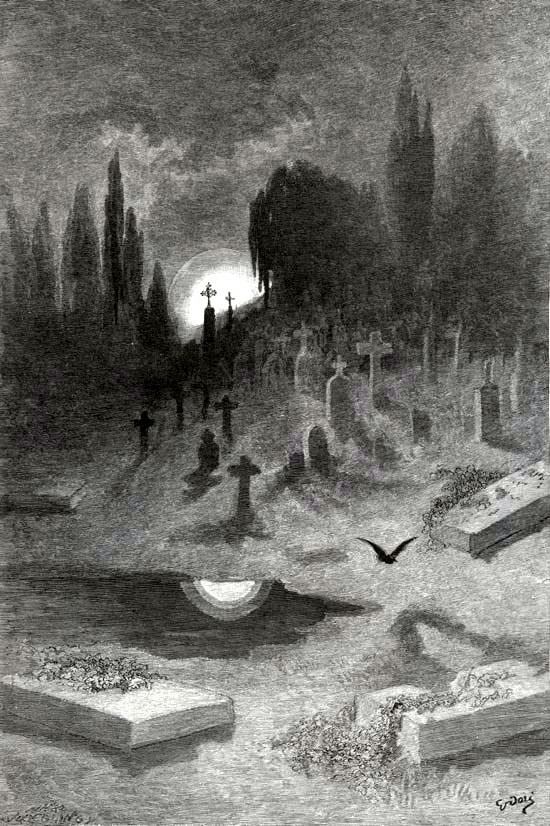
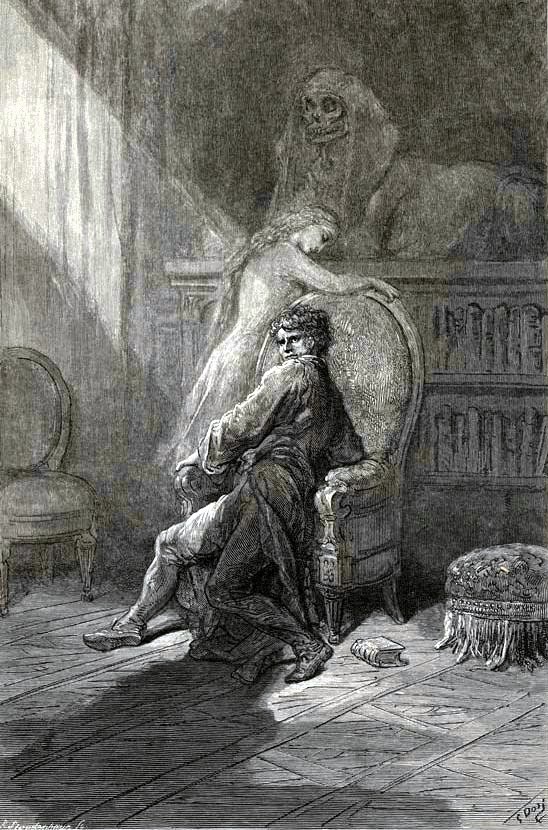
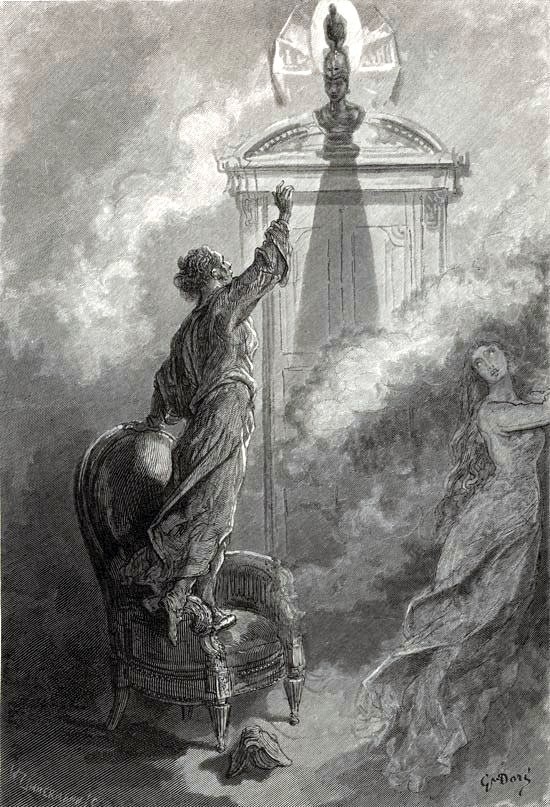
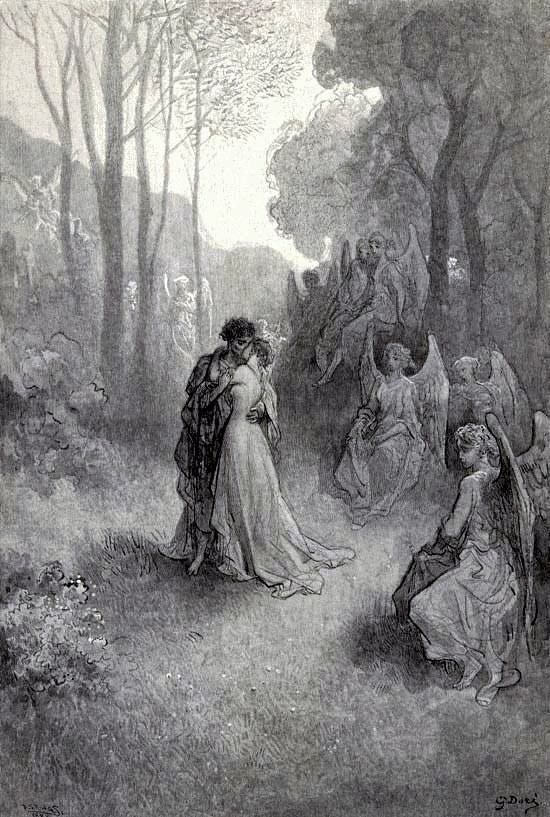
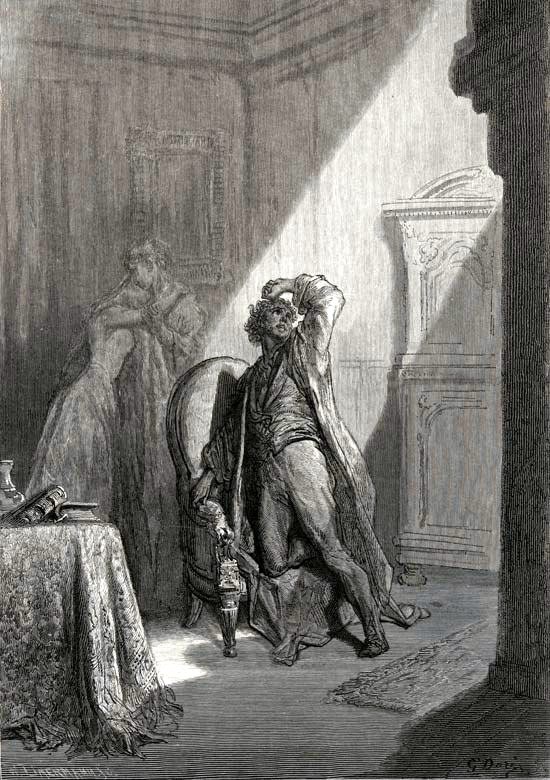
Explore More Dore Engravings
Edouard Manet — Le Corbeau (The Raven), 1875
Manet's lithographs for Le Corbeau represent one of the earliest and most important examples of the livre d'artiste (artist's book) — where illustration is treated as primary artistic collaboration, not decoration. Published in 1875 by Richard Lesclide, this edition paired Poe's original English text with a French translation by the Symbolist poet Stephane Mallarme. Manet created a series of transfer lithographs — drawing directly onto paper before transferring to stone — which gave his imagery a spontaneous, painterly quality unprecedented in book illustration. Only about 150-240 copies were originally produced, and contemporary critics attacked its modernist imagery. Today it is regarded as a watershed moment in the intersection of visual art and literature.
Where to See & Buy Manet's Le Corbeau
Collector's Note: Original 1875 editions are among the rarest artist's books in the world. Only 150-240 copies were produced. Modern reproductions and individual plate prints are available from $20 (poster) to $655 (facsimile edition) to $10,000+ (original plates at auction).
John James Audubon — Plate 101: The Common Raven
In the original monumental Double Elephant Folio of The Birds of America (1827-1838), Plate 101 features the Common Raven (Corvus corax) — a single adult perched on a weathered branch, rendered at life size. Audubon's hand-colored etching, engraved by Robert Havell Jr. in London, captures the bird's intelligence and imposing presence with meticulous naturalistic detail. As the largest perching bird in North America, the raven required a full-sized plate to accommodate its wingspan and proportions. The original Havell prints (1829) are among the most sought-after items in natural history art — complete folios have sold for over $11.5 million at auction.
Editions & Reproductions
Edition Notes: 1829 Havell Edition: original hand-colored etching (life-size). 1840 Octavo Edition: smaller format, Plate 101 shows the Mourning Warbler (different numbering). 1937/1941 Bookplates: double-sided prints with Raven on one side, Blue Jay (Plate 102) on reverse. Modern giclee prints range from $50-$500.
Kawanabe Kyosai — The Samurai Raven Prints
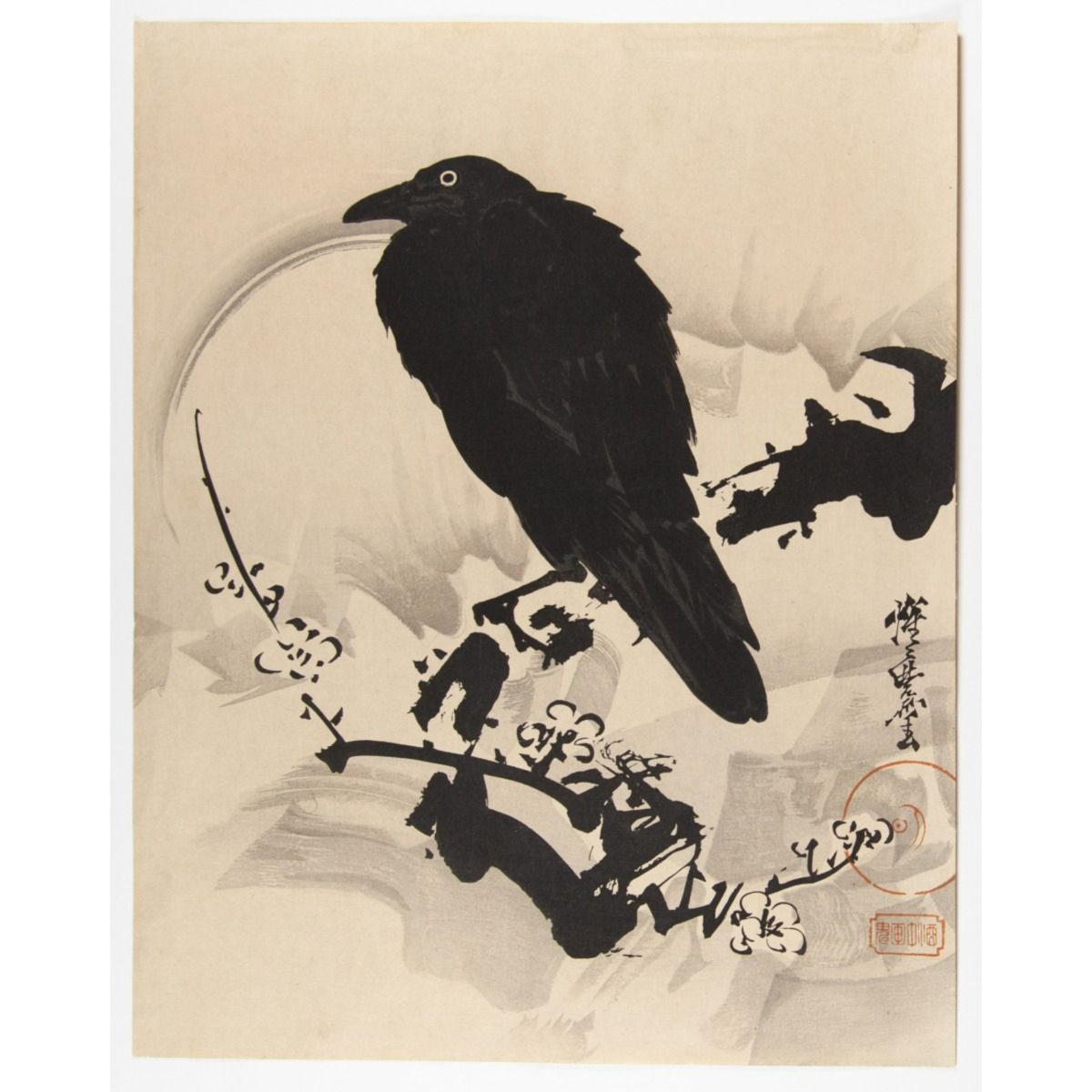
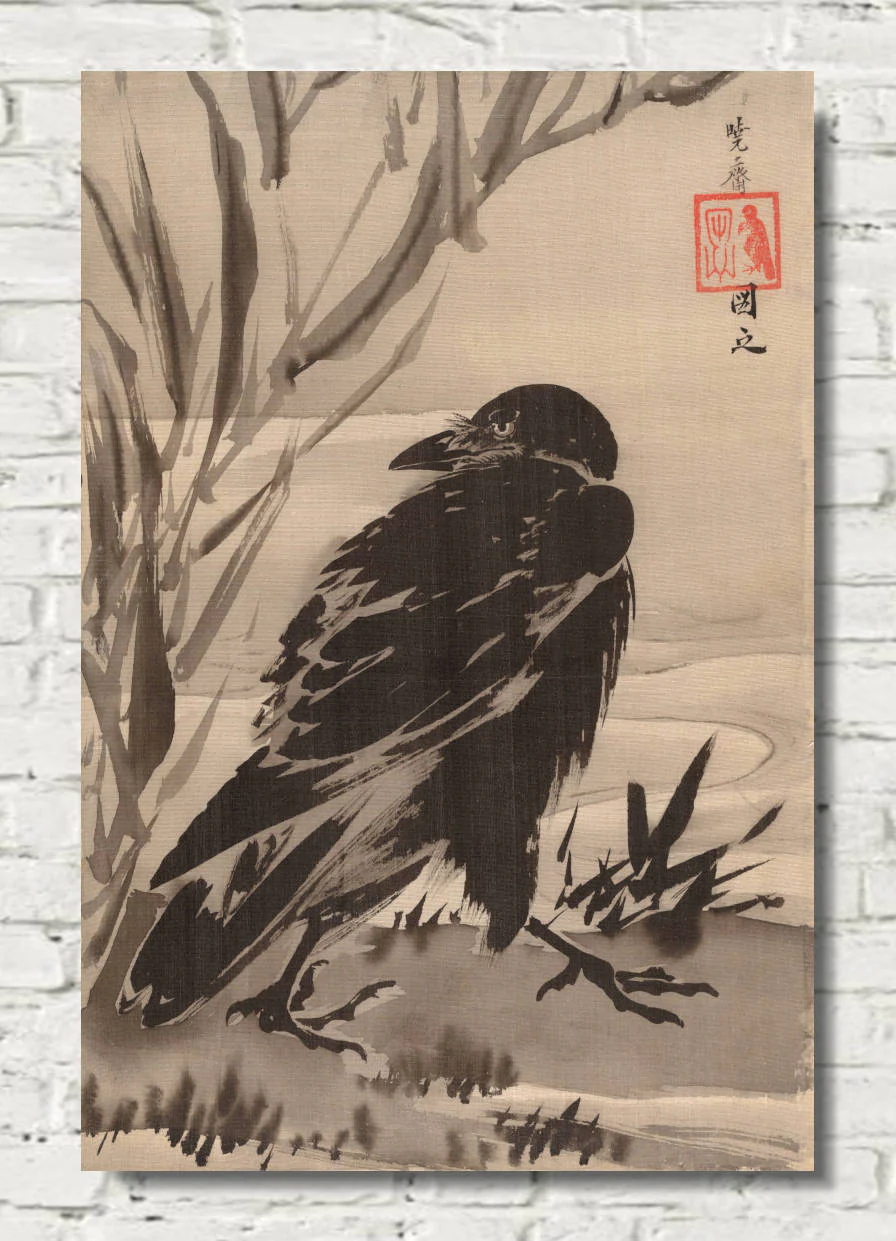
Kawanabe Kyosai (1831-1889) was one of the last great masters of Japanese painting, known as the "demon of painting" (gaki). A student of both the traditional Kano school and of ukiyo-e, Kyosai became famous for his virtuosic, often satirical ink paintings — and his crows and ravens are considered among the greatest animal paintings in Japanese art history. His raven works combine spontaneous sumi-e (ink wash) brushwork with an almost supernatural understanding of the bird's form, capturing the corvid's intelligence, posture, and plumage with a few bold, confident strokes. Kyosai could render a convincing raven in seconds — and he famously painted while drunk, sometimes producing his finest work in this state. His raven paintings consistently achieve the highest prices at auction among all his works.
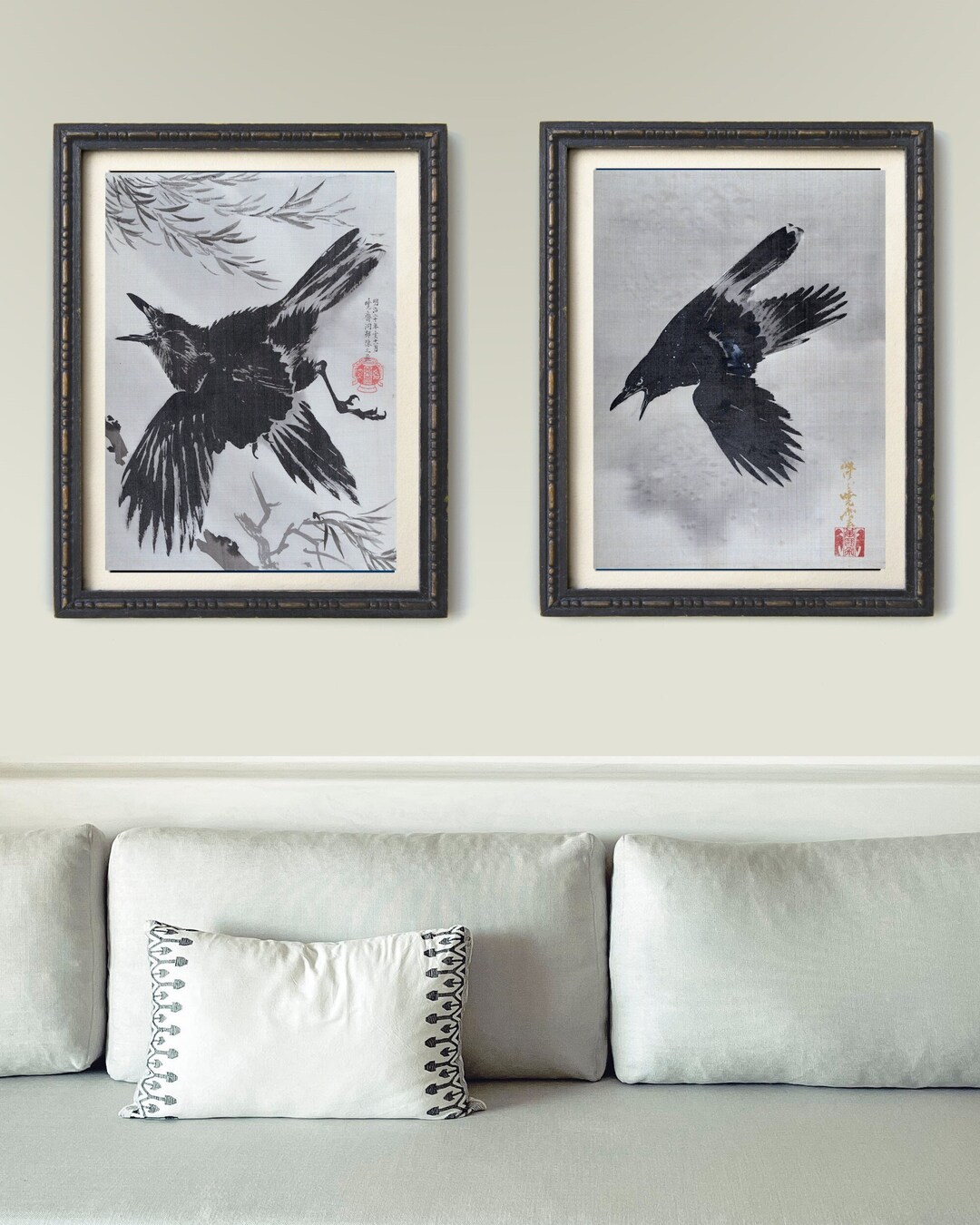
Why Kyosai's Ravens Matter for Design
Kyosai's raven paintings demonstrate something crucial for modern mark-making: the power of reduction. His crows are rendered with minimal brushstrokes — sometimes three or four — yet they are unmistakably alive, unmistakably corvid, unmistakably present. This is the same principle Paul Rand advocated: strip away everything that isn't essential, and what remains is more powerful than any amount of detail. Kyosai proves that a raven can be captured in its essence with almost nothing — and that essence is what a great mark should pursue.
Visual Mood Board — Asian Traditions
Visual Mood Board — Latin Culture
Visual Mood Board — Indigenous & Formline Art
Visual Mood Board — Science & Anatomy
Visual Mood Board — Brands & Military
Visual Mood Board — Tower of London
Design, Illustration & Portfolio Sources
Dribbble — Logo & Illustration
Behance — Portfolio Projects
ArtStation — Concept Art & Fantasy
DeviantArt — Community Illustration
Comics & Media Reference
Tattoo Design Collections
Free Stock Photography
Logo & Vector Collections
Museum & Archive Collections
Pinterest Boards & Community Collections
Major Curated Boards
Themed Searches
XV — Designing the Raven: Strategic Symbol Principles
How does a new raven mark achieve cultural resonance, competitive differentiation, and timeless design integrity? This section synthesizes the principles of Paul Rand, the frameworks of Logos That Last (Alan Peters), Logo Design Love (David Airey), Designing Brand Identity (Alina Wheeler), and the broader canon of symbol-making — applied specifically to the raven archetype.
What a New Raven Symbol CAN Be
1. An Abstraction of Intelligence, Not a Literal Bird
Paul Rand's central thesis: a logo is not an illustration, it is a signal. The IBM eye-bee-M, the UPS shield, the Apple apple — none describe the product. They encode a feeling. A raven mark at its best abstracts the bird's essential qualities — watchfulness, angular geometry, strategic presence — into a form that transcends species identification. The viewer should feel "intelligence in flight" before they think "bird." Rand wrote that the role of the designer is to communicate, not to decorate — the raven must mean something, not just depict something.
2. Geometrically Distinctive — The "Napkin Test"
Alan Peters argues in Logos That Last that the strongest marks pass the napkin test: can someone who saw your logo once draw a recognizable version on a cocktail napkin? The raven's silhouette is inherently strong — angular beak, heavy corvid brow, hunched posture, splayed primaries. A successful raven mark would isolate the one geometric gesture that is unmistakably raven and unmistakably yours. Consider: the angular descent of the beak creating a downward vector of intent. The "shoulder hunch" that distinguishes corvids from all other passerines. The splayed wing-tip primaries that look like fingers reaching. One of these gestures, reduced to its geometric essence, becomes ownable.
3. Built on a Grid, Born from Structure
Alina Wheeler's Designing Brand Identity emphasizes that enduring marks are built on mathematical relationships — golden ratios, circular arcs, consistent stroke weights. The raven's anatomy actually lends itself to grid construction: the corvid skull is roughly circular; the beak extends at approximately 30 degrees below the horizontal plane; the hackle feathers (throat ruff) create a triangular vector below the head. A mark that uses these natural proportions — circle (head), triangle (hackle), acute angle (beak) — would feel both engineered and organic.
4. A Symbol of Transformation, Not Just Power
The raven across virtually every culture is a transformer — it brings fire, steals the sun, carries souls, bridges worlds. A raven mark that captures this liminal quality — the sense of crossing thresholds, of being between states — would be culturally resonant and narratively rich. This could manifest as: a raven emerging from shadow into light (split composition), a raven whose silhouette contains a second reading (figure-ground reversal, a la the FedEx arrow), or a mark where the negative space tells its own story.
5. Scalable Across Every Medium
Peters insists that a logo must work at 16x16 favicon size and at billboard scale. A raven mark must reduce to a single recognizable gesture at 12px and expand into a richly detailed brand world at mural scale. This demands a modular approach: the primary mark (simple geometric raven), a secondary mark (raven + wordmark), and an expanded brand illustration system (detailed raven artwork for immersive applications). The primary mark alone must be legible as a monochrome silhouette, as a single-color stamp, and as a full-color rendering.
6. Ownable Through a Specific Posture or Behavior
The most differentiated animal marks in design history choose a specific moment: the Lacoste crocodile has its mouth open. The Puma is mid-leap. The Jaguar is lunging. A raven mark should choose its moment deliberately — and that moment should reflect brand values. A raven in flight communicates freedom and vision. A raven perched with head cocked communicates curiosity and intelligence. A raven mid-call with beak open communicates voice, prophecy, herald energy. A raven carrying something in its beak — Promethean theft, the trickster returning with stolen fire. Each posture is a different brand story.
7. Rich in Narrative Layers (The "Story Mark")
Wheeler notes that the strongest brands are built on stories, not features. The raven is perhaps the most narratively loaded animal symbol in human history — more than the lion, eagle, or wolf. A new raven mark can tap into any of these narrative layers: Odin's wisdom-seekers (thought and memory), Poe's midnight visitor (the uncanny), Indigenous trickster-creator (transforming reality), corvid intelligence research (problem-solving), or the tower guardians (protection of kingdoms). The key is choosing one primary narrative and letting the others resonate as overtones, not chords.
What a New Raven Symbol CANNOT Be
1. NOT a Jose Cuervo Echo — The Heraldic Crow Trap
Jose Cuervo's mark is the most commercially prominent raven/crow symbol in the Americas. It uses a heraldic, front-facing, wings-spread crow in the European coat-of-arms tradition. Any new raven mark that uses a front-facing, symmetrical, wings-spread corvid will read as "tequila brand" or "Cuervo knockoff" to millions of consumers. Avoid bilateral symmetry with spread wings in a heraldic pose.
2. NOT a Baltimore Ravens Duplicate — The Athletic Aggressive Raven
The Baltimore Ravens NFL mark is a shield-shaped aggressive raven head in purple with a strong angular beak and fierce eye. Any new raven mark that uses an aggressive, forward-facing raven head in a shield shape with sports-style rendering will be seen as an NFL derivative. A new mark must either be more abstract, more elegant, or more conceptual. The aggressive sports-mascot raven is taken.
3. NOT a Generic "Bird Logo" — The Clip-Art Trap
Rand was relentless about this: a symbol must be specific. Generic bird silhouettes communicate nothing. A raven mark must be unmistakably a raven, not a crow, not a blackbird, not a generic raptor. The anatomical differentiators matter: the massive beak with its curved culmen, the shaggy throat hackles, the wedge-shaped tail (not fan-shaped like a crow), the heavy brow ridge.
4. NOT "Edgy for Edgy's Sake" — The Hot Topic Trap
The raven has been co-opted heavily by goth, metal, horror, and Halloween aesthetics. Dripping blood, glowing red eyes, skulls, pentagrams — these associations are powerful but limiting. A raven mark intended for a sophisticated brand cannot lean into horror tropes. The distinction: Tim Burton's aesthetic (stylized, narrative, warm-dark) vs. generic horror (gratuitous, one-dimensional, cold-dark). Think of how Bentley uses a pair of wings to communicate luxury flight, not aggression.
5. NOT Culturally Extractive — The Appropriation Trap
The raven is sacred to many Indigenous peoples — Tlingit, Haida, Kwakwaka'wakw, Tsimshian, and others. Their formline art (ovoid shapes, U-forms, split designs) is a highly specific cultural visual language developed over millennia. A new commercial mark cannot use Pacific Northwest formline design elements without direct Indigenous collaboration and consent. The principle: be informed by cultural traditions, do not take from them.
6. NOT Overly Complex — The Craft Beer Trap
Rand's rule: if it needs to be explained, it's too complex. A raven mark with individually rendered feathers, detailed talons, intricate wing patterns, and realistic proportions is an illustration, not a mark. The test: can it be embossed on a leather goods tag at 15mm? Can it be stitched on a hat at 1 inch? Can it be cut from a single piece of metal? If not, it's artwork, not a logo.
7. NOT Static When It Should Be Living
Modern brand systems demand responsive marks. A raven symbol designed only as a static vector will underperform in digital-first environments where animation, interaction, and micro-motion are expected. The raven's real-world behavior — head-cocking, wing-spreading, calling, soaring — provides a natural motion vocabulary. But the static mark must be perfect first; motion is an enhancement, not a crutch.
Competitive Landscape: Existing Raven Marks
To differentiate, you must first map what exists. Here is the territory already claimed:
| Mark | Category | Visual Language | Territory Claimed |
|---|---|---|---|
| Jose Cuervo | Spirits | Heraldic front-facing crow, crest | Latin heraldic raven |
| Baltimore Ravens | NFL Sports | Aggressive shield-head, purple | Athletic/aggressive corvid |
| Corvus Coffee | F&B / Coffee | Minimalist perched profile | Clean artisan corvid |
| Raven Industries | Aerospace/Ag Tech | Geometric flying raven | Tech/engineering precision |
| Tower of London | Heritage/Tourism | Literal raven illustration | Historical guardianship |
| Odin/Viking brands (various) | Apparel/Lifestyle | Knotwork, Norse motifs | Norse mythology space |
| Raven Software | Gaming | Stylized dark raven | Gaming/entertainment |
| AeroVironment RQ-11 | Military UAV | Text/silhouette | Military/surveillance tech |
| Game of Thrones (Three-Eyed Raven) | Entertainment IP | Three-eyed mystical raven | Fantasy/mystical prophecy |
| Yatagarasu / JFA | Sports/Mythology | Three-legged sun crow | Japanese sacred crow |
The white space: no major brand has claimed the raven as a symbol of quiet intelligence, modern transformation, creative strategy, or cultural bridging. The aggressive, heraldic, and literal territories are crowded. The conceptual, elegant, and narrative territories are wide open.
Strategic Principles for a Truly New Raven Mark
Principle 1: Lead with Negative Space (Rand's "Second Reading")
Paul Rand believed the greatest marks contain a second reading — something the eye discovers after the first impression. The FedEx arrow. The Spartan Golf Club golfer-in-the-gap. The raven's anatomy offers extraordinary negative-space opportunities: the gap between beak and breast creates a natural enclosed space. The spread wing primaries create finger-like gaps. The wedge tail creates a V-form. A mark where the negative space reveals something — a hidden initial, a conceptual symbol, a geographic feature — would be both distinctive and memorable.
Principle 2: Choose One Anatomical Truth (The "Species Signature")
Every great animal mark isolates one anatomical feature and elevates it. The Jaguar's mark is really about the leap. Lacoste is about the open jaw. For the raven, the most distinctive anatomical features are: the massive arched beak with its pronounced nasal bristles, the shaggy throat hackles (no other common bird has this), the diamond/wedge tail shape (crows have fan tails), and the "finger" wing-tip primaries. The hackle feathers are especially compelling — they're the raven's "beard," its mark of gravitas, and they're virtually unique in the avian world.
Principle 3: Build a System, Not Just a Mark (Wheeler's "Brand Architecture")
Wheeler's framework insists that a logo is the tip of a visual identity system. A raven mark must be designed as the keystone of an entire visual language: primary mark, secondary mark, icon system, pattern library, illustration style, photography direction, motion principles, and sonic identity. The raven's behavioral repertoire provides the system vocabulary: soaring (vision/aspiration), perching (observation/patience), calling (voice/prophecy), caching (strategy/preparation), tool-using (innovation/craft), tumbling in flight (play/creativity).
Principle 4: Honor the Darkness Without Being Dark (The "Elevated Shadow")
The raven is inherently associated with darkness, death, shadow, the uncanny. A sophisticated brand doesn't run from this — it elevates it. The darkness of the raven is the darkness of depth, not of horror. It's the darkness of a well-aged whiskey, a hand-rubbed walnut table, a moonless sky that reveals the stars. The color story should embrace deep tones — obsidian, anthracite, midnight — but pair them with warmth: aged gold, tarnished brass, deep amber, wine. The raven's plumage isn't just black — it's iridescent purple, green, blue, bronze. The mark should live in a world where "black" is actually rich and prismatic.
Principle 5: Be Culturally Fluent, Not Culturally Extractive
The raven appears in Norse, Celtic, Indigenous Pacific Northwest, Japanese, Aztec/Nahua, Iberian, Roma, Tibetan, and dozens of other traditions. A new mark can be informed by all of these without taking from any of them. Reference the universal qualities that all cultures recognize in the raven (intelligence, transformation, boundary-crossing, prophecy) and express them through original visual language. The raven is a bridge between worlds — your mark should bridge traditions without copying them.
Principle 6: Design for the Century, Not the Decade (Peters' "100-Year Test")
Peters asks: will this mark still work in 100 years? The marks that last are structurally simple, conceptually rich, and stylistically neutral. Shell, Mercedes, Apple, Nike, Chanel — all are essentially geometric primitives with one idea. A raven mark built on a trend will date within five years. A raven mark built on a geometric truth — the angle of the beak, the arc of the wing, the mass of the head — will endure because it's built on anatomy, not aesthetics.
Principle 7: The Mark Must Work in Black, on Black, and AS Black
Because the raven is black, the mark must have an exceptional relationship with darkness. It should work as a black mark on white (standard), as a white mark on black (inverted), and — most distinctively — as a black mark on near-black (the "dark on dark" challenge). If the mark can be debossed on black leather, foil-stamped in dark gunmetal on a black box, or rendered in matte black on glossy black — and still be legible and beautiful — it has achieved something rare. This is the raven's natural habitat: visible in the dark.
The Raven in Modern Brand Storytelling
For Modern Culture
The raven maps perfectly to the cultural moment. We live in an age of information overload — the raven is the creature that sorts signal from noise (Huginn: thought; Muninn: memory). We live in an age of transformation — career pivots, identity evolution, reinvention as survival — and the raven is the archetypal transformer. We live in an age that valorizes intelligence over brute force — and the corvid family represents the pinnacle of non-human cognitive achievement.
For a Modern Brand
A raven mark positions a brand as: knowing (not naive), strategic (not reactive), creative (not derivative), dark-but-not-grim (sophisticated shadow palette), culturally deep (not trend-chasing), and intellectually confident (not loud). This is the brand personality of a consulting firm, a design studio, a premium spirits label, a heritage goods company, a strategic advisory, or a creative technology company. In brand archetype terms, the raven is the Sage-Creator-Magician intersection — the rarest and most compelling brand personality territory.
For Modern Storytelling & Narrative
In narrative terms, the raven is always the herald or the mentor — never the hero. This is its power. In the StoryBrand framework, the raven is the Guide — the entity that has been through the transformation already and now helps others navigate it. In the Hero's Journey, the raven appears at the threshold, at the descent into the underworld, and at the return. In Dan Harmon's Story Circle, the raven is present at steps 3 (enter the unfamiliar) and 7 (return, changed). A brand that positions itself as the raven is positioning itself as the guide.
Respecting Heritage & Culture
The guiding principle is stewardship, not ownership. No brand owns the raven — it belongs to human mythology. Acknowledge the cultural lineages in brand storytelling (reference Norse, Indigenous, Latin, Asian traditions with respect and specificity). Collaborate with Indigenous artists if the brand's visual language intersects with their traditions. Never claim the raven symbolism as "invented" or "original" — position the brand as the latest chapter in an ancient story. And critically: the mark itself must be new. It must be an original contribution to the visual tradition of the raven, not a recombination of existing cultural elements.
The Opportunity: A Raven Mark That Has Never Existed
The competitive analysis reveals a clear opening. The existing raven marks fall into four categories: heraldic (Cuervo, Lisbon, Tower), aggressive (Baltimore Ravens, gaming), literal/naturalistic (Corvus Coffee, Raven Industries), and mystical/fantasy (Three-Eyed Raven, Norse lifestyle brands). None of them occupy the space of quiet, modern, strategically intelligent, culturally resonant abstraction.
The mark that doesn't exist yet is one that abstracts the raven to its geometric essence (Rand), contains a second reading in negative space (Rand, Peters), is built on a mathematical grid from corvid anatomy (Wheeler), isolates one species-specific anatomical truth (Peters), works in monochrome at 12px and debossed on leather and animated in motion, honors cultural heritage without extracting visual language, feels like wisdom not aggression, functions as the keystone of a full visual identity system (Wheeler), and passes the 100-year test — built on anatomy, not aesthetics (Peters).
That mark — the one that threads the needle between ancient symbol and modern abstraction, between cultural depth and competitive distinction, between darkness and sophistication — is the one worth making. It is the mark that earns the right to stand in the lineage of Dore, of the formline masters, of the Norse wood carvers, of the Aztec codex painters. Not by copying them, but by understanding what they understood — and translating it into a visual language that belongs to now.
Source Framework: Paul Rand, A Designer's Art (1985) & Design, Form, and Chaos (1993). Alan Peters, Logos That Last (2022). David Airey, Logo Design Love (2009). Alina Wheeler, Designing Brand Identity (5th ed., 2017). Additional: Sagi Haviv & Michael Bierut on mark-making; Jessica Hische on lettering-as-mark; Michael Johnson, Branding: In Five and a Half Steps (2016).
The raven is the Shadow Guide — the archetype of necessary darkness, boundary-crossing intelligence, and transformation through paradox.
It sees what others cannot, goes where others will not, and returns with knowledge that changes everything.
Compiled from exhaustive research spanning mythology, etymology, taxonomy, anatomy, cognitive science, literature, pop culture, branding, sports, military, art history, heraldry, music, counterculture, Latin culture, strategic symbol design, and the principles of Paul Rand, Alan Peters, Alina Wheeler, and David Airey.